
Exploring Peptide Therapy: Benefits, Research, FDA Approval & Safety
Exploring Peptide Therapy: The Science, Benefits, and Safety Behind This Growing Wellness Trend
Understanding how peptides work, what the research really shows, and why choosing safe, medically supervised treatments matters.
Peptide therapy has become one of the most talked-about topics in health and wellness. From weight management and metabolic health to muscle recovery, tissue repair, and healthy aging, peptides are generating excitement for their potential to support the body's natural biological processes.
But with growing popularity comes an important question: Are peptide therapies truly safe and effective, or is the excitement moving faster than the science?
At Kingdom Wellness, we believe patients deserve accurate information, thoughtful guidance, and access to treatments supported by sound medical evidence. Understanding the science behind peptides—and the differences between FDA-approved medications, investigational therapies, and unregulated products—is essential before considering treatment.
What Are Peptides, and How Do They Work?
Peptides are short chains of amino acids, the building blocks of proteins. They occur naturally throughout the human body and play important roles in regulating many biological functions.
Think of peptides as biological messengers. They can communicate with cells and help coordinate processes such as:
Hormone signaling: Helping regulate certain hormonal pathways and physiological responses.
Metabolism and appetite: Influencing hunger, blood sugar regulation, and energy balance.
Tissue maintenance and repair: Participating in processes involved in healing and cellular communication.
Immune function: Helping regulate certain immune and inflammatory responses.
Growth and development: Supporting normal physiological growth and tissue function.
Our bodies naturally produce many different peptides. Insulin, glucagon, and several hormones involved in appetite regulation are examples of peptide-based signaling molecules.
Peptide therapy involves administering a specific peptide or peptide-based medication to influence a particular biological pathway.
However, not all peptides work the same way, and their effects depend on their structure, dose, route of administration, and the biological systems they target.
Why Is Everyone Talking About Peptide Therapy?
Interest in peptide therapy has expanded significantly, particularly as researchers explore treatments for metabolic disease, obesity, hormonal disorders, and other medical conditions.
Some peptide-based medications have already transformed how certain diseases are treated. Others are still being investigated for potential applications involving:
Weight management and metabolic health
Muscle preservation and physical recovery
Wound healing and tissue repair
Inflammatory conditions
Hormonal and growth-related disorders
Age-related changes in health and function
These areas of research are exciting, but there is an important distinction between a treatment that shows promise in early laboratory studies and one that has demonstrated meaningful clinical benefits in humans.
Scientific potential does not automatically mean proven effectiveness or established safety.
What Does the Research Currently Show?
Peptide research spans a wide spectrum, from well-established FDA-approved medications to experimental compounds with limited human data.
1. Metabolic Health and Weight Management: Strong Clinical Evidence
Some of the most compelling advances in peptide-based medicine involve medications that target hormones responsible for appetite and blood sugar regulation.
Examples include:
Semaglutide (Wegovy and Ozempic)
Semaglutide is a glucagon-like peptide-1 (GLP-1) receptor agonist. It mimics the activity of a naturally occurring hormone involved in blood sugar regulation, appetite, and feelings of fullness.
Clinical trials have demonstrated significant benefits for weight management and type 2 diabetes in appropriate patient populations. Certain semaglutide products also have FDA-approved indications for reducing specific cardiovascular and other health risks.
Tirzepatide (Zepbound and Mounjaro)
Tirzepatide acts on two hormone receptors, GIP and GLP-1, helping regulate appetite and glucose metabolism.
Large clinical trials have demonstrated substantial weight reduction and improvements in several metabolic health measures.
These medications illustrate how peptide-based therapies can move from scientific discovery to clinically meaningful, evidence-supported treatment.
However, even FDA-approved medications have risks, contraindications, and potential side effects. They should be prescribed only after an appropriate medical evaluation.
2. Tissue Repair and Recovery: Promising but Preliminary
Peptides such as BPC-157 and TB-500 are frequently promoted online for muscle recovery, tendon injuries, inflammation, and tissue healing.
Much of the enthusiasm comes from laboratory experiments and animal studies investigating biological pathways involved in tissue repair.
While these findings are scientifically interesting, there are important limitations.
BPC-157: Research has explored possible effects on tissue healing and inflammation, but high-quality human clinical evidence remains extremely limited. Its safety, effective dosing, and long-term effects in humans have not been established.
TB-500: Often marketed as a synthetic peptide related to thymosin beta-4, TB-500 has insufficient reliable human clinical evidence to establish safety or effectiveness for injury recovery. Research involving thymosin beta-4 or related compounds should not automatically be interpreted as proof that commercially marketed TB-500 products are safe or effective.
Neither BPC-157 nor TB-500 is FDA-approved for human therapeutic use.
For patients interested in injury recovery, it is important to understand that encouraging early research does not replace well-designed clinical trials.
3. Growth Hormone and Body Composition: Benefits Depend on the Medical Indication
Certain peptides influence the body's growth hormone pathways.
For example, sermorelin stimulates growth hormone release through growth hormone-releasing hormone receptors. Other compounds, including CJC-1295 and ipamorelin, are marketed for similar purposes.
These peptides are sometimes promoted for:
Improving body composition
Supporting muscle development
Enhancing exercise recovery
Improving sleep
Promoting healthy aging
However, evidence supporting these broad wellness claims is limited.
Stimulating growth hormone release does not necessarily translate into improved health, physical performance, or longevity. Potential risks can include changes in glucose metabolism, fluid retention, and other hormonal effects.
Some medications targeting growth hormone pathways have FDA-approved uses for specific medical conditions, but those approvals should not be generalized to other peptides or anti-aging applications.
4. Longevity and Healthy Aging: An Emerging Field
Researchers are also studying peptides involved in cellular signaling, mitochondrial function, and age-related biological processes.
Compounds such as MOTS-c and epitalon have attracted attention in longevity discussions.
Although early research may suggest interesting biological activity, convincing human evidence demonstrating that these compounds safely extend lifespan or improve long-term health outcomes is lacking.
At present, many peptides marketed for longevity remain experimental.
Patients should be especially cautious of products promising to reverse aging, regenerate organs, or dramatically improve lifespan without strong clinical evidence.
FDA-Approved vs. Non-FDA-Approved Peptides: What's the Difference?
One of the most important things patients should understand is that FDA-approved and non-FDA-approved do not mean the same thing as effective and ineffective—but they represent very different levels of regulatory review and certainty.
FDA-Approved Peptide Medications
When a medication receives FDA approval, the manufacturer has submitted scientific evidence supporting its safety and effectiveness for specific medical indications.
The FDA evaluates factors including:
Clinical trial results
Known benefits and potential risks
Manufacturing quality and consistency
Appropriate dosing and administration
Labeling, warnings, and contraindications
FDA approval does not mean a medication is completely risk-free. It means the FDA has determined that its benefits outweigh its known risks for its approved use under the conditions described in its labeling.
Examples of FDA-approved peptide-based medications include insulin products, semaglutide, tirzepatide, and certain medications used for specific hormonal disorders.
What About Peptides That Are Not FDA-Approved?
A peptide that is not FDA-approved has not completed the FDA review process establishing its safety and effectiveness for the proposed use.
This may mean the compound is still being researched, lacks sufficient human clinical evidence, or has unresolved manufacturing or safety concerns.
Importantly, the absence of FDA approval does not automatically mean a substance is illegal in every circumstance. Some investigational drugs can be administered through properly authorized clinical trials or other legally permitted pathways.
However, a product being available for purchase online does not establish that it is legal to market for human treatment, appropriately manufactured, or safe to administer.
What About Compounded Peptides?
Compounding is the process of preparing a customized medication for an individual patient's medical needs.
Legitimate compounding can serve an important role in healthcare, particularly when an FDA-approved medication cannot meet a patient's specific needs.
However, compounded medications are not FDA-approved, and the FDA does not evaluate each compounded preparation for safety, effectiveness, or quality before it is marketed.
Additionally, not every peptide can legally be compounded. Federal and state regulations restrict which substances may be used, and some peptides raise specific safety concerns.
A prescription or the involvement of a pharmacy does not automatically make an investigational peptide legally permissible or clinically appropriate.
At Kingdom Wellness, we believe decisions about compounded medications should involve careful consideration of the patient's medical needs, available FDA-approved alternatives, current regulations, and the evidence supporting the proposed treatment.
An evolving regulatory landscape: In October 2026, federal health officials introduced a conditional enforcement-discretion policy involving six investigational peptides-BPC-157, TB-500, KPV, MOTS-c, epitalon, and Semax. Under specified conditions, the policy describes circumstances in which federal authorities do not intend to pursue enforcement against certain compounding activities. Although this may create limited pathways for qualifying compounding activities, it does not establish FDA approval, proven effectiveness, or long-term safety. Patients should continue to prioritize legitimate medical oversight, appropriately regulated pharmacies, and transparent discussions about the limitations of available research.
You can read more about the FDAs stance on peptides, compounding, grey market substances and safety when buying medications online at the articles below:
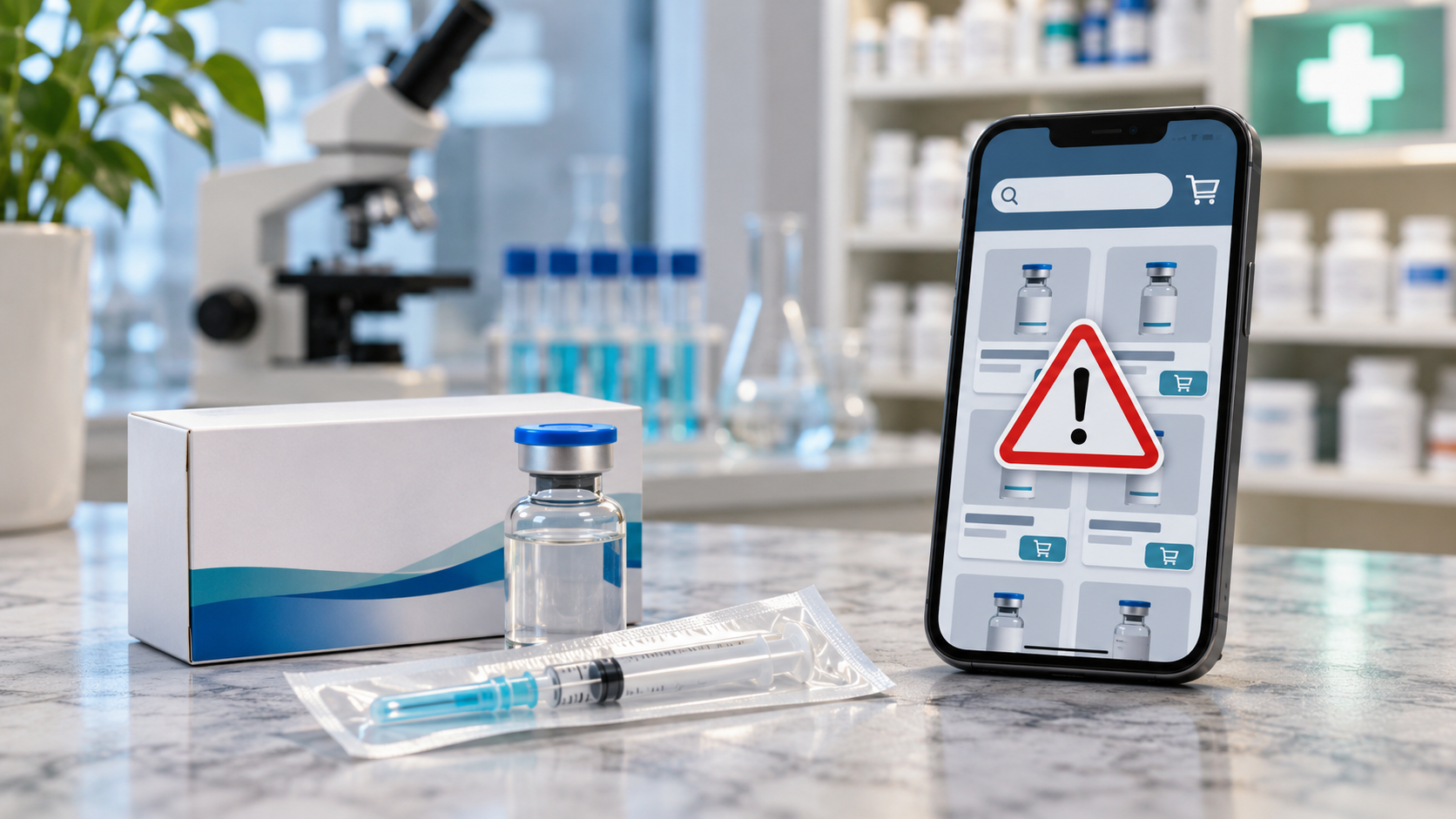
The Dangers of the "Grey Market" Peptide Industry
As interest in peptide therapy grows, so does the online market for products labeled as "research peptides."
These products are frequently advertised through websites, social media, fitness communities, and online marketplaces.
Some are sold with disclaimers such as:
"For research purposes only. Not for human consumption."
Despite these warnings, products may be promoted in ways that encourage consumers to inject or otherwise administer them.
This creates serious safety concerns.
1. Unknown Purity and Contamination
Products purchased through unregulated sources may contain impurities, bacterial contamination, endotoxins, or unwanted chemical byproducts.
For injectable products, contamination can lead to serious infections, inflammatory reactions, or other complications.
2. Incorrect Ingredients or Potency
A vial labeled as containing a specific peptide may not contain the advertised substance or concentration.
Independent verification is often absent or difficult to establish.
This creates risks of unintended exposure, underdosing, overdosing, and unpredictable biological effects.
3. Improper Storage and Handling
Peptide stability can depend on temperature, light exposure, formulation, and storage conditions.
Improper handling may reduce potency or compromise product quality.
Injectable products also require appropriate sterile preparation and administration.
4. Misleading Marketing Claims
Claims such as "heals injuries rapidly," "reverses aging," or "completely safe because it's natural" should raise concerns.
Natural occurrence in the body does not guarantee that administering additional amounts of a substance is safe.
5. Lack of Medical Oversight
Self-administering peptides without appropriate medical guidance can result in missed contraindications, medication interactions, adverse effects, or delayed diagnosis of underlying medical conditions.
A product being widely discussed online—or used by influencers—does not make it a medically validated treatment.

How Can Patients Access Peptide Therapies More Safely?
For patients considering peptide-based treatments, the safest approach begins with a qualified healthcare professional who understands the relevant medical condition, available treatments, and current evidence.
Before starting treatment, consider these questions:
Is this peptide FDA-approved for my condition?
If not, ask why it is being recommended, what human evidence supports its use, and whether legally available, better-studied alternatives exist.
Where is the medication coming from?
FDA-approved prescription medications should be obtained through appropriately licensed pharmacies and legitimate distribution channels.
When a compounded medication is medically necessary and legally permitted, it should come from a properly licensed, regulated compounding pharmacy operating under applicable federal and state requirements.
Has the product undergone appropriate quality testing?
Quality assurance matters, especially for sterile injectable medications. However, a seller's certificate of analysis alone does not establish that a product is safe, sterile, FDA-approved, or appropriate for human use.
What are the potential risks and benefits?
A responsible provider should discuss the strength of the evidence, expected benefits, known and unknown risks, alternatives, and whether any monitoring is appropriate.
Is this treatment actually necessary?
Sometimes the best approach involves established therapies, nutrition, physical activity, sleep, rehabilitation, or addressing underlying medical conditions rather than pursuing an experimental treatment.
Our Approach at Kingdom Wellness
At Kingdom Wellness, we're excited by the possibilities of medical innovation, including advances in peptide-based medicine.
We also recognize that responsible healthcare requires more than following the latest wellness trends.
Our philosophy centers on personalized, evidence-informed care that considers the whole person—not simply a symptom, a laboratory result, or a trending treatment.
When discussing peptide therapy, we prioritize:
Education: Helping patients understand what is established, what remains experimental, and what questions to ask.
Safety: Considering medication quality, regulatory status, potential risks, and appropriate clinical monitoring.
Individualized care: Evaluating each patient's health history, goals, and medical needs.
Transparency: Being clear about the limitations of current research and avoiding exaggerated promises.
Responsible innovation: Remaining informed about emerging therapies while recognizing the importance of high-quality evidence.
Our goal is not to recommend every new treatment. It is to help patients make informed decisions about therapies that may genuinely benefit their health.
The Bottom Line: Exciting Science Deserves Responsible Medicine
Peptide therapy represents a fascinating and rapidly evolving area of medicine.
Some peptide-based medications already have substantial clinical evidence and FDA approval for specific conditions. Others remain experimental, with significant unanswered questions about effectiveness, safety, and long-term outcomes.
As interest continues to grow, patients deserve to know the difference.
The future of peptide medicine may be promising, but safe, effective treatment should always come before trends and marketing claims.
Curious About Peptide Therapy?
Whether you're exploring metabolic health, weight management, hormone-related concerns, or other wellness goals, our team at Kingdom Wellness is here to help you understand your options.
We welcome thoughtful conversations about emerging therapies, the science behind them, and how evidence-based care can support your long-term wellness.
Your health deserves more than hype. It deserves thoughtful, personalized care.
Learn more about Kingdom Wellness
Medically reviewed by Nancy Ashby, MSN, APRN, FNP-C
Medical Disclaimer: This article is intended for educational purposes only and does not constitute individualized medical advice. Discussion of a peptide does not indicate that Kingdom Wellness offers, recommends, prescribes, or endorses that compound. Some peptides discussed are investigational and are not FDA-approved for human therapeutic use. Always consult a qualified healthcare professional before starting or changing medical treatment.